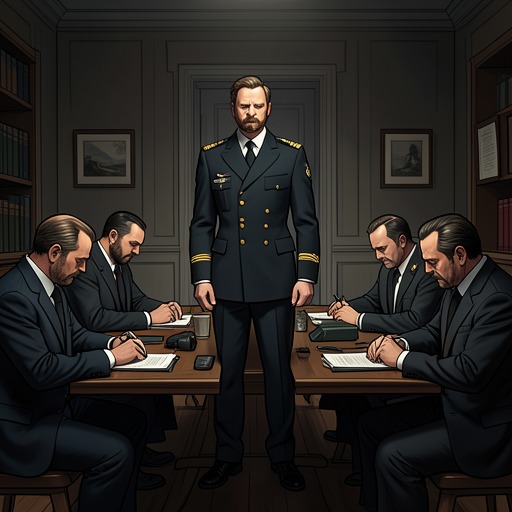
Willie Keith’s Changing Regard for Captain Queeg
The Caine Mutiny Court-MartialWillie Keith’s changing regard for Captain Queeg is a movement from hopeful admiration to disillusionment, fear, and a more complicated understanding of failure. Their relationship begins as a personal encounter colored by Willie’s wish to escape Captain de Vriess’s command, but becomes a test of his place in Queeg’s increasingly rigid order. In the courtroom, the private change acquires public stakes: Queeg’s fitness and conduct are disputed, and the circumstances under which Steve Maryk took command become a matter of evidence and judgment.
First Impressions and a Promising Transfer
Before meeting the new captain, Willie lies in the clipping shack trying to read Kant’s Critique of Pure Reason, borrowed from Tom Keefer. His attention keeps wandering from the page to the problem of imagining the man who is expected to free him from what he regards as Captain de Vriess’s tyranny. The scene establishes that Willie approaches Queeg with an expectation already shaped by his dissatisfaction with the existing command.
When Captain de Vriess summons him to the wardroom, Willie hurries into his cleanest khakis and stabs his thumb while changing his collar pins. He enters sucking the injured thumb, an awkward sign of the immaturity that colors the first meeting. Queeg, dressed in immaculate blues with two campaign ribbons and a battle star, is small and slightly shorter than Willie. Willie notices his fair, somewhat plump face, narrowed eyes, nearly bald head, and sandy hair. Yet it is not his appearance that decides the encounter. Queeg rises, shakes Willie’s hand firmly, and greets him with cordial good humor. Willie likes him at once.
The exchange also begins with a transfer of authority. Captain de Vriess asks Willie to prepare a registered-publications inventory and transfer report for the new commander, then tells Queeg that Willie is his. After de Vriess withdraws and closes his cabin door, Willie turns to Queeg with a mischievous grin and welcomes him aboard. Queeg responds warmly and proposes that they get started. For Willie, the handover seems to promise a more congenial relationship with the person now in command.
From Personal Warmth to Enforced Discipline
The initial impression does not disappear all at once; it is overtaken by Queeg’s demands. Soon after assuming command, Queeg tells Willie that he is out of restriction and calls the reprieve an amnesty. Willie thanks him warmly. But the relief is folded into a larger relationship in which Queeg’s favor and authority are inseparable. Even as he releases Willie, Queeg is inspecting the quarterdeck and rolling steel balls in his hand, noticing that Captain de Vriess has not yet been logged out. The gesture of leniency takes place inside a regime of scrutiny.
Queeg then appoints Willie morale officer in addition to his other duties. The first assignment is to ensure that every sailor tucks his shirttail inside his trousers. Queeg treats appearance as a visible measure of whether the crew is acting like sailors and warns that violations will reflect not only on the sailor and department head but also on Willie. The order turns Willie’s new responsibility into an exposed point of accountability: he is expected to enforce a standard across the ship and answer personally when it is not met.
That structure becomes tangible on the bridge. Willie has been relaxing shirtless on the fantail when Queeg summons him in an emotional, strident announcement. He finds Urban standing rigidly at attention with his shirttail hanging out, while Queeg glowers and Tom Keefer stands nearby twisting his binocular lenses. Queeg turns to Willie as morale officer and demands an explanation. Willie tries to question the sailor, but Queeg rejects the explanation that Willie had been away from the bridge, treating it as an alibi rather than an answer to the failure of enforcement. He orders Willie to submit a written report. A rule that had sounded like a manageable uniform instruction has become a demonstration that Queeg holds Willie answerable for failures he cannot always prevent.
Command Judgment and the Loss of Confidence
The gap between Queeg’s cordial first impression and his later command becomes more consequential when the USS Caine loses its target. After the towline parts, Queeg orders the ship to steam two miles. The target dwindles to a stationary dot, and he announces that it has not been recovered. He writes a dispatch describing the defective towline, the target adrift as a navigation hazard, and his return to base, recommending that a tug recover or destroy it the following morning.
Queeg presents his decision to Steve Maryk as a matter of responsibility: in his view, a defective towline is not an emergency that requires him to spend the Navy’s time searching. He directs Tom Keefer to obtain a course back to Pearl Harbor. Maryk privately asks Keefer whether Queeg understands that the ship has gone around in circles and cut the target loose; Keefer answers that he does not know what goes on in Queeg’s mind and warns that they are in trouble. The episode places Queeg’s self-protective account beside the officers’ recognition of what has happened. It also gives Willie’s earlier trust a larger context: command is no longer only a question of how the captain treats him, but of whether the captain’s version of events can be relied upon.
At Kwajalein, Willie watches the bombardment from the flying bridge with striking detachment. He smokes, whistles Cole Porter tunes, and regards the spectacle as entertaining, while the narrative stresses how easily the combatants on both sides cease to regard one another as human. This scene does not resolve Willie’s view of Queeg, but it helps mark the experience through which that view develops: military service exposes him to situations whose apparent order and success can conceal their human cost.
Crisis, Testimony, and the Limits of Authority
The typhoon strips away the distance between shipboard authority and physical danger. Willie cannot understand Maryk’s maneuver as the executive officer uses the ship’s turn, engines, and rudder to bring its bow toward the wind and sea. Sitting in water and clinging to a telephone jackbox, Willie has lost faith in the ship and can think only of being saved. His experience makes command judgment immediate and bodily: in the storm, the abstract question of who is right gives way to the danger of being aboard a vessel in violent seas.
The court-martial later forces the conflict over Queeg’s command into a formal contest of expertise. During Barney Greenwald’s questioning of the Navy psychiatrists, Greenwald summarizes a cluster of behaviors attributed to Queeg: rigidity, feelings of persecution, unreasonable suspicion, withdrawal from reality, perfectionist anxiety, an unreal basic premise, and obsessive self-righteousness. Dr. Lundeen insists that the symptoms are mild and compensated. Greenwald presses Dr. Bird on the difference between describing Queeg as disturbed and calling him sick, then challenges the assumption that a psychiatric assessment settles whether Queeg was disabled for command. The dispute is therefore not simply over a label; it concerns whether medical judgment can determine the practical demands of command.
When Queeg testifies, Greenwald asks whether the USS Caine was in the last extremity at the moment Maryk relieved him on the morning of December 18. Queeg answers that it certainly was not. The exchange puts Queeg’s own account directly against the central question of the relief. His denial does not erase the danger Willie experienced in the storm, but it establishes how sharply the event’s meaning differs according to the position from which it is judged: Queeg speaks as the captain who was relieved; Willie’s experience is that of an officer terrified on a ship whose command has become a matter of survival.
Retrospective Judgment
The relationship’s final note is not a simple restoration of Willie’s early admiration. After the USS Caine is struck by a kamikaze, Tom Keefer asks Willie why he stayed aboard. Willie explains that he had seen the actual damage amidships while Keefer had not, and that Keefer was wounded and shocked. Keefer answers that he would still have jumped. He says that his intelligence leaves him imprisoned by the fact that he abandoned ship, whereas Queeg could swallow his own self-protecting lies because he was stupid. Willie objects that Keefer is injured and that his self-condemnation makes no sense.
Keefer then asks whether Willie left the steel balls on his pillow. The question connects Queeg’s recurring hand-played steel balls to the moral accounting that continues after the emergency: an object associated with Queeg has become a prompt for Keefer’s shame and Willie’s unspoken acknowledgment of what the command has come to mean. The novel does not return Willie to the innocence of his first greeting. Instead, his regard for Queeg is reframed by the difference between a friendly welcome, the burdens of enforcing Queeg’s orders, the disputed judgment of the typhoon, and the consequences of fear. Their relationship traces Willie’s movement from wanting a better captain to recognizing that command must be judged by conduct under pressure, not by warmth at the first meeting.